
A field is never just a field
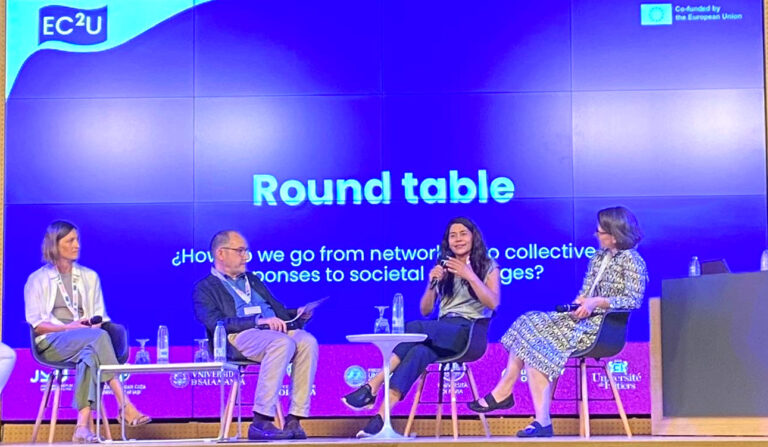
Picture a regional meeting where farmers, researchers, local authorities, and technology providers sit around the same table. Everyone agrees that soil health matters, but each person sees the challenge from a different angle.
The farmer is thinking about productivity and costs.
The researcher is thinking about data and long-term soil indicators.
The policymaker is thinking about climate targets.
The entrepreneur is thinking about scalable solutions.
The real challenge is not convincing people that healthy soils are important. The challenge is helping them work together in ways that turn knowledge into action.
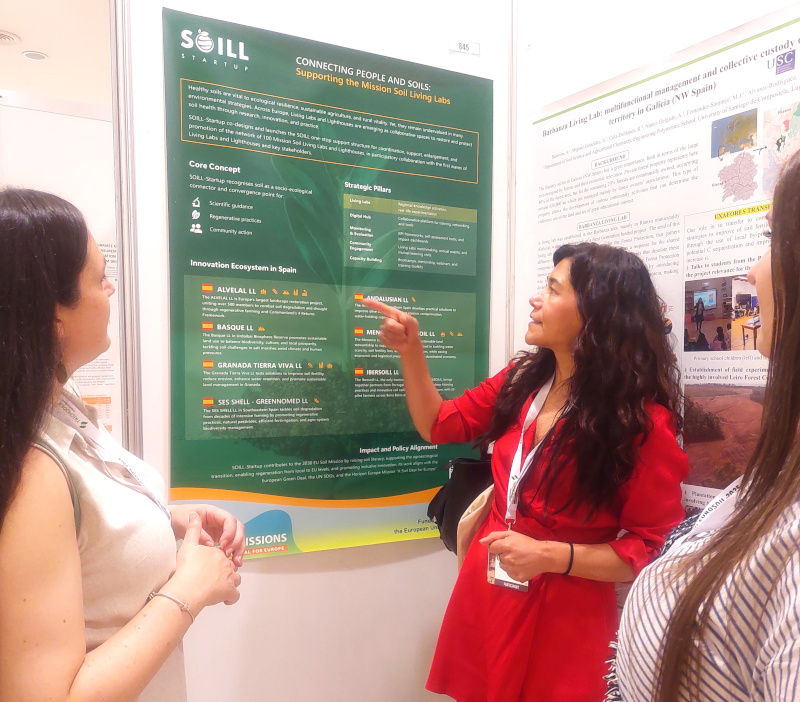
That is the starting point of the SOILL-Startup initiative, presented in the poster Connecting People and Soils: A Mission-Oriented Ecosystem for Soil Health Living Labs. The project supports the EU Soil Mission’s ambition to establish 100 Soil Health Living Labs across Europe by connecting farmers, researchers, local actors, and communities through training, collaboration, digital tools, and shared learning.
A Soil Health Living Lab is not just a research site. It is a shared space where farmers, researchers, businesses, public institutions, and communities test and adapt solutions together.
This matters because soil challenges are local. A practice that works in one region may not work in another. Climate, crops, traditions, water availability, market pressures, and community priorities all shape what is possible.
Living Labs make responsible innovation practical. Instead of designing solutions far from the people who will use them, they bring stakeholders into the process early. This reduces the risk of creating tools, policies, or practices that look good on paper but fail in the field.
For small businesses and entrepreneurs, this is a valuable lesson: innovation works better when users are not treated as “end recipients,” but as co-creators.
The role of digital tools and Responsible AI
The poster highlights the role of a digital Hub and collaborative platform to connect stakeholders, support mutual learning, enable matchmaking, and strengthen capacity-building.
This is where Responsible AI and AI for Sustainability can play an important role.
AI can help analyze soil data, monitor changes, identify risks, recommend regenerative practices, or connect farmers with relevant expertise. But AI should not replace local knowledge. It should support it.
A responsible AI approach in soil health means asking:
Is the tool understandable for farmers and advisors?
Does it work for small farms, not only large ones?
Is the data reliable and locally relevant?
Are communities involved in deciding how technology is used?
Does the technology create shared value, or only extract data?
AI for Good becomes meaningful when digital tools help people collaborate, learn, and make better decisions for the land.
Participation is not a soft issue—it is infrastructure
One of the strongest ideas in the SOILL-Startup model is that collaboration is not an extra activity. It is central to the mission.
Training, engagement, evaluation, knowledge sharing, and community building are all part of the support structure. This is important because sustainable transitions rarely fail only because of missing technology. They often fail because people do not trust the solution, understand it, or see how it fits their reality.
For consultants and practitioners, this is a key insight. If you want adoption, you need more than a good tool. You need relationships, incentives, communication, and practical support.
Responsible innovation depends on trust.
Gender-inclusive and community-driven innovation
The poster also refers to gender-inclusive innovation and community engagement. This is important because sustainability transitions must be fair as well as effective.
In rural innovation, some voices are often more visible than others. Women, young farmers, smallholders, and local community actors may have valuable knowledge but less influence in formal decision-making spaces.
A responsible Soil Health Living Lab should create room for those perspectives. Not because inclusion is a slogan, but because better decisions come from understanding the full reality of a place.
Inclusive innovation helps ensure that soil health solutions are not only technically sound, but socially accepted and locally useful.
Practical lessons for entrepreneurs and SMEs
For small businesses, agricultural advisors, consultants, and innovation teams, the SOILL-Startup approach offers several practical lessons.
First, start with the ecosystem, not just the product. Soil health solutions need farmers, researchers, local authorities, technology providers, and communities working together.
Second, design for adoption. A solution must be affordable, understandable, and relevant to local conditions.
Third, use digital tools to connect people, not isolate them. Platforms, dashboards, and AI systems should strengthen collaboration and knowledge exchange.
Fourth, measure progress in more than financial terms. Soil health, learning, trust, participation, biodiversity, and resilience are also signs of value.
Finally, build for replication without ignoring local context. A good model can be shared across regions, but it must remain flexible enough to adapt.
Closing takeaway
Soil health is not only a scientific challenge. It is a social, economic, and innovation challenge.
The future of sustainable agriculture will not be built by technology alone, or by policy alone, or by farmers alone. It will be built through ecosystems where people learn together, test solutions together, and care for the land together.
The practical takeaway is clear: healthy soils need healthy collaboration. Responsible innovation begins when we connect people, knowledge, technology, and place.
For more information, you can access it here:
Baran, G., & Berkowicz, A. (2021). Digital platform ecosystems as living labs for sustainable entrepreneurship and innovation: a conceptual model proposal. Sustainability, 13(11). https://doi.org/10.3390/su13116494
Gamache, G., Anglade, J., Feche, R., Barataud, F., Mignolet, C., & Coquil, X. (2020). Can living labs offer a pathway to support local agri-food sustainability transitions? Environmental Innovation and Societal Transitions, 37, 93–107. https://doi.org/10.1016/j.eist.2020.08.002
Montes de Oca Munguia, O., Pannell, D. J., & Llewellyn, R. (2021). Understanding the adoption of innovations in agriculture: A review of selected conceptual models. Agronomy, 11. https://doi.org/10.3390/agronomy11010139
Rochecouste, J. F., Dargusch, P., Cameron, D., & Smith, C. (2015). An analysis of the socioeconomic factors influencing the adoption of conservation agriculture as a climate change mitigation activity in Australian dryland grain production. Agricultural Systems, 135, 20–30. https://doi.org/10.1016/j.agsy.2014.12.002